

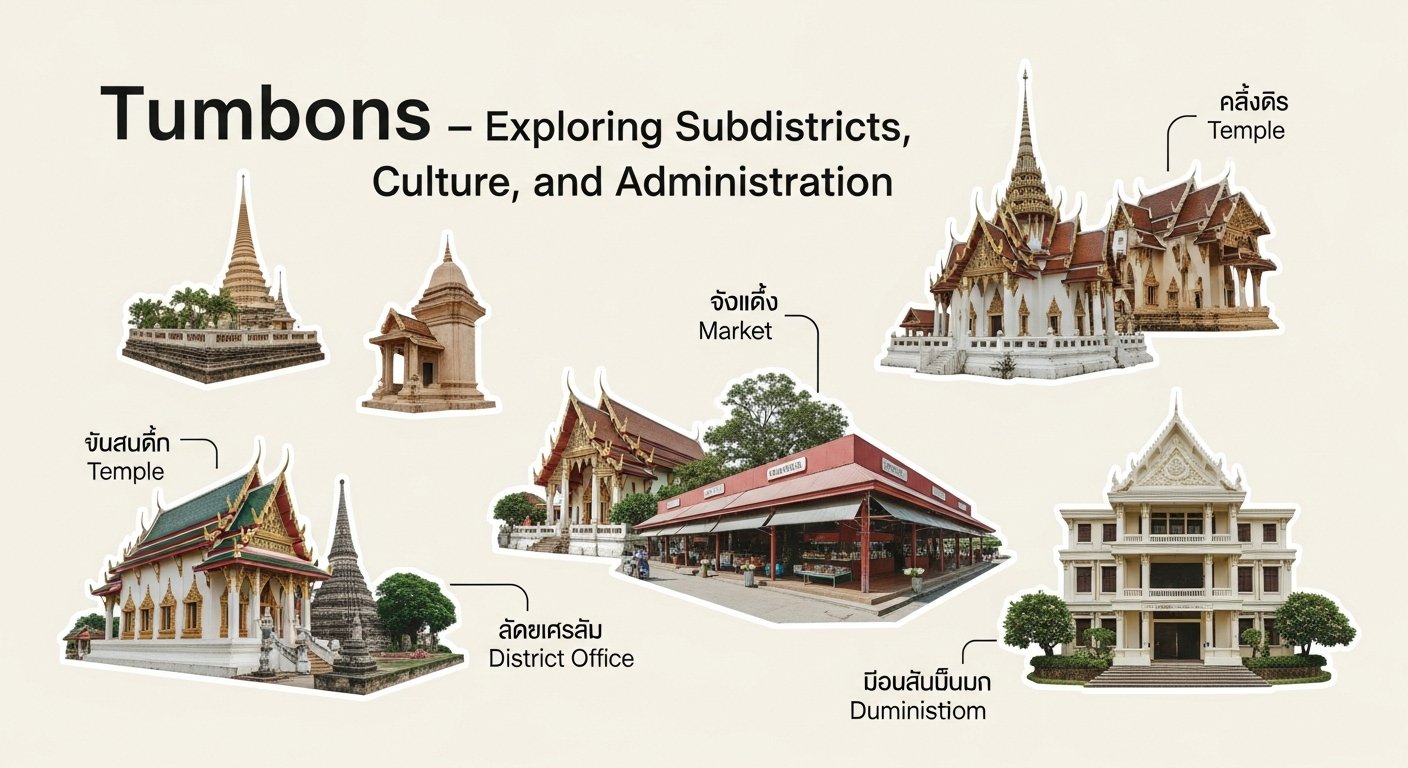
When it comes to understanding the local governance and cultural structure of Thailand, the concept of tumbons is central. A tumbon, often translated as a subdistrict, represents the third-level administrative division in Thailand, situated below provinces (changwat) and districts (amphoe). While it may seem like a small administrative unit, tumbons play a vital role in the lives of residents, shaping governance, culture, community services, and daily life.
This article explores the history, structure, governance, culture, and significance of tumbons, providing a comprehensive look at one of Thailand’s foundational administrative units.
What Are Tumbons?
The word tumbon refers to a subdistrict, which is a subdivision of a district (amphoe) in Thailand. Each province is divided into multiple districts, and each district is further divided into tumbons.
-
Hierarchy of administrative divisions in Thailand:
-
Province (Changwat)
-
District (Amphoe)
-
Subdistrict (Tumbon)
-
Village (Muban)
-
Tumbons serve as a bridge between local villages and district authorities, handling administrative tasks, public services, and community development programs.
Historical Background of Tumbons
The administrative structure of Thailand has evolved over centuries, influenced by the Ayutthaya Kingdom, Thonburi era, and the Rattanakosin Kingdom. Originally, local governance was largely informal, relying on village leaders and regional lords.
With the Thesaphiban reforms under King Chulalongkorn (Rama V) in the late 19th and early 20th centuries, Thailand introduced a more structured administrative system. Tumbons were formalized as official subdistricts to improve governance, tax collection, and resource management.
Today, tumbons are governed under the Tambon Administrative Organization (TAO) or Subdistrict Administrative Organization (SAO), ensuring localized decision-making and community representation.
Administrative Structure of Tumbons
Tambon Administrative Organization (TAO)
The TAO is the governing body of a tumbon, responsible for administration, public services, and local development.
-
Leadership:
Each TAO is led by an elected chief executive (nai tambon) and a council. Council members are elected by residents of the subdistrict. -
Responsibilities:
-
Infrastructure development (roads, bridges, public buildings)
-
Waste management and sanitation
-
Education and cultural programs
-
Health services and public safety
-
Local taxation and budget management
-
Villages (Muban)
Tumbons are further divided into villages or mubans, each led by a village headman (phu yai ban). The village headman coordinates with the TAO to ensure community needs are met.
-
Villages typically consist of 100–500 households, depending on population density.
-
Local committees may focus on specific community concerns like farming, water management, or festivals.
Cultural Significance of Tumbons
Beyond administration, tumbons are cultural hubs, preserving local traditions, practices, and festivals. Each subdistrict has its own identity shaped by history, geography, and ethnic composition.
Festivals and Traditions
Tumbons host various local festivals, often connected to religion, agriculture, or history:
-
Songkran (Thai New Year): Celebrated with water festivals, parades, and temple visits.
-
Loy Krathong: Floating lantern celebrations in rivers and lakes, often coordinated by local communities.
-
Harvest festivals: Traditional ceremonies expressing gratitude for bountiful crops, common in rural subdistricts.
Religious and Community Centers
-
Temples (Wat): Act as both religious and community centers, hosting ceremonies, education programs, and cultural activities.
-
Community Halls: Locations for local meetings, civic events, and celebrations.
Through these activities, tumbons help maintain social cohesion, passing traditions to younger generations while fostering a sense of community identity.
Economic Life in Tumbons
Tumbons are also economic units, supporting local livelihoods and markets. Economic activities vary depending on geography and resources:
-
Agriculture: Rice farming, fruit orchards, and livestock are common in rural subdistricts.
-
Small Businesses: Markets, handicrafts, and local shops thrive in semi-urban tumbons.
-
Tourism: In tourist-friendly areas, tumbons benefit from cultural tours, homestays, and local craft sales.
The TAO often supports these economic initiatives by providing infrastructure, market spaces, and development programs.
Education and Public Services
Education and basic services are closely linked to tumbon administration:
-
Schools: Primary and secondary schools are often managed with support from TAOs.
-
Health Centers: Community health clinics provide preventive care, vaccinations, and basic treatment.
-
Water and Sanitation: Local authorities ensure clean water access and waste disposal systems.
By managing these services at a subdistrict level, Thailand ensures that residents have direct access to essential services without always needing to go to district or provincial centers.
Challenges Facing Tumbons
Despite their importance, tumbons face challenges in governance and development:
Resource Limitations
-
Some TAOs have limited budgets, affecting their ability to maintain infrastructure or fund projects.
-
Smaller subdistricts may struggle with staff shortages and administrative capacity.
Urbanization
-
Rapid migration to cities can depopulate rural tumbons, reducing economic activity and civic engagement.
Environmental Issues
-
Water scarcity, deforestation, and pollution are growing concerns, requiring TAOs to implement sustainable practices.
Digital Transformation
-
While technology adoption is increasing, some rural tumbons still lack digital infrastructure for education, governance, and communication.
Modernization and Innovation in Tumbons
Many subdistricts are embracing modern governance and technology:
-
E-Government Services: Online platforms for tax payment, permit applications, and public service requests.
-
Smart Agriculture: Using IoT devices and mobile apps to improve crop yields and monitor resources.
-
Renewable Energy Projects: Solar panels and small hydropower initiatives support sustainability.
-
Cultural Tourism Promotion: Websites, social media, and apps highlight local heritage and attract visitors.
These innovations allow tumbons to remain relevant and competitive, balancing tradition with modernization.
The Role of Tumbons in Thai Society
Tumbons are more than administrative units—they are the heart of community life. They facilitate participation in local governance, preserve cultural heritage, support economic development, and ensure residents’ welfare.
By understanding tumbons, we gain insight into how Thailand manages local democracy, cultural identity, and development at a grassroots level.
Key Takeaways
-
Tumbons are subdistricts, forming the third level of Thailand’s administrative structure.
-
Governed by TAOs, they handle public services, infrastructure, and local development.
-
They preserve cultural traditions, festivals, and social cohesion.
-
Tumbons support local economies, ranging from agriculture to tourism.
-
Modernization, e-governance, and innovation are shaping the future of these subdistricts.
In essence, tumbons embody the balance between administration, culture, and community, making them a crucial part of Thailand’s governance and social landscape.
Conclusion
Tumbons – Exploring Subdistricts, Culture, and Administration highlights the significance of subdistricts in Thailand’s administrative hierarchy and community life. They are the link between villages and districts, bridging governance, culture, and everyday life. By studying tumbons, one can appreciate how local governance, cultural preservation, and community development come together to form the foundation of Thai society.
As Thailand continues to modernize, tumbons will continue to adapt, integrating technology, sustainable practices, and innovative governance methods while remaining deeply rooted in tradition and local identity.